Best Reader For Books Mac
It also supports Calibre, the industry-standard e-book library manager. With Calibre, you can sync your books to other e-book readers, convert e-books, manage your library, and more. 24 thoughts on “ Top Three Free Epub Readers for Mac OS X ” Pingback: The Best Free App for Watching Videos on Mac OS X| Mac Mojo. Pingback: Download and Install Adobe Digital Editions to Read Epubs on Mac OS X. Ehon is a great comic book reader as well as ebook reader. Best Features of Adobe Reader for Mac Adobe Reader for Mac is a capable PDF viewer that allows you to view, print, and annotate PDF files for free. If you register with Adobe, you can connect Adobe Reader for Mac to Adobe Document Cloud, which is a suite of cloud-based software applications from Adobe Systems that provides PDF-related services, including conversion and document exchange.
When the Kindle appeared, readers realized that years of false starts and empty promises were over, that the e-reading revolution had really and finally arrived. And then, a kind of Cold War set in between two kinds of readers: bibliophiles who insist that wood pulp—the musty smell of real paper!—is the best way to read, and the rest of us, who increasingly love the convenience of the digital ebook era.
They’re both right.
For the first time in history, when we sit down to read a book, we’re faced with more than simply a choice of what to read—we must also decide how to read it. Perhaps you've found your favorite reading method, and tend to stick with it. But the truth is that different mediums offer different strengths, which are in turn tuned to different types of reading. Wedging yourself into a corner with just one device for all types of reading can deny you the pleasures and advantages of the other.
In the last two years, I’ve read books in numerous ways: a desktop computer, a netbook, my iPhone, my iPad, an e-ink Kindle, and—believe it or not—a good old-fashioned paper book. (I even listened to Jonathan Franzen’s Freedom with the Audible.com iPhone app.) The strength of those first three options, in most cases, was that they’re available: If you need to read something now, they’ll do in a pinch.
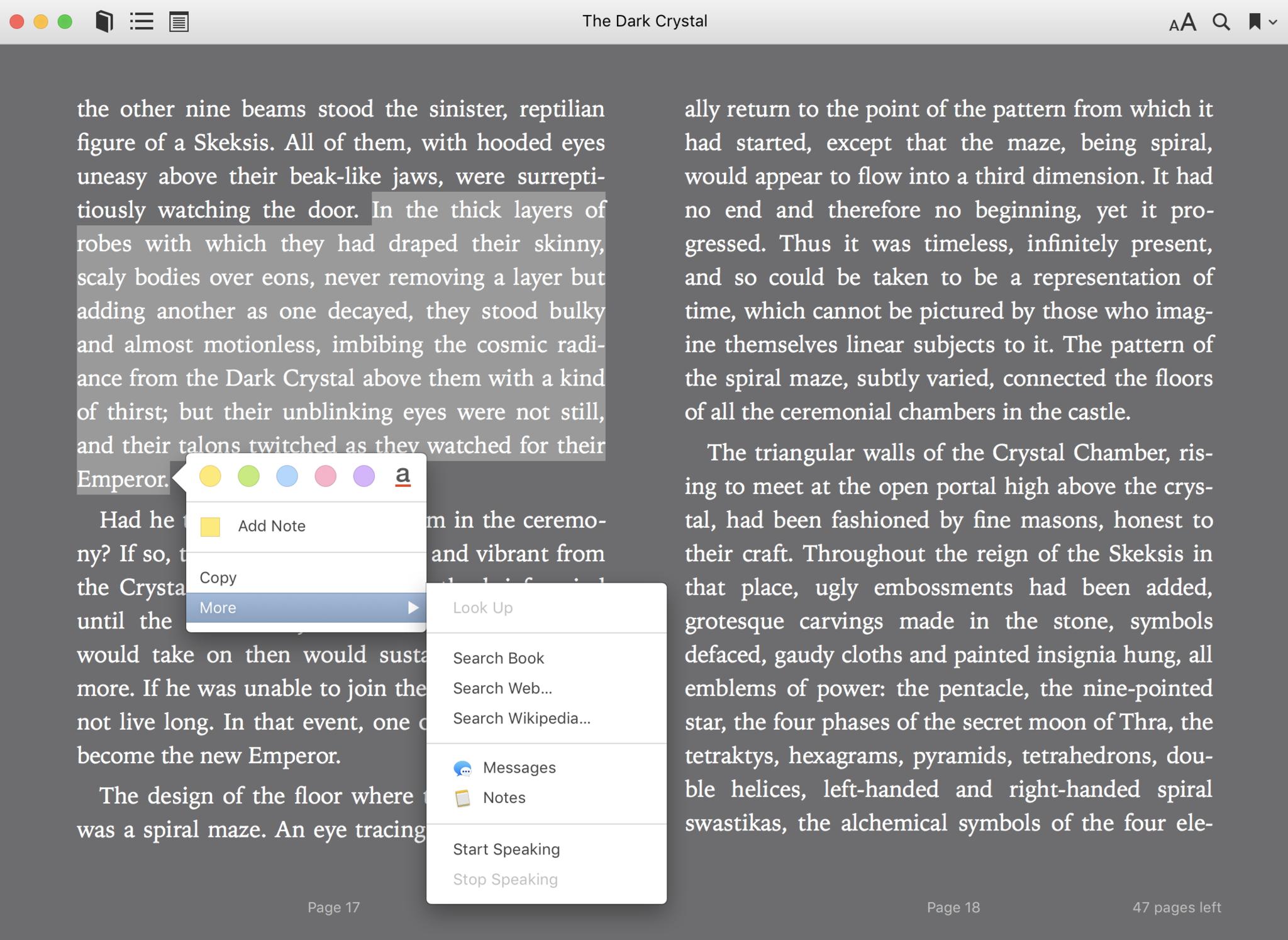
Mostly, though, I stick to the iPad, a basic model e-ink Kindle, or paper. The iPad is the closest thing to my default reading device, for reasons I’ll get to in a second, but it’s never an automatic choice. Why? Because each has its advantages.
For studious reading, I prefer the iPad. Yes, I’ve been out of college for years now, but in one of my other journalistic pursuits I co-host a podcast featuring interviews with authors of books on politics and policy. That means lots of reading, lots of highlighting, and lots of note-taking. The iPad is clearly best at the latter two tasks, especially the note-taking. And it keeps getting better in that regard: Amazon recently updated its Kindle iOS app to offer several different colors of highlighter ink, making it easier to color-code your notes in a book as you go. That’s a feature shared by Apple’s iBooks app as well, as both companies work to appeal to the educational and textbook markets.
This isn’t necessarily deep reading: The iPad facilitates note-taking and skimming—the kind of reading done by college students. But at the end of a book, it’s so much easier to go back, find your notes, and give yourself a Cliff’s Notes overview of what you just read. If you’re in information-processing mode, the iPad is usually the way to go. Making and navigating these sorts of notes on an e-ink Kindle is painful.
For light reading, the basic e-ink Kindle is the way to go: It’s the cheap dime-store paperback that’s always with you. If you’re not into deep note-taking, but merely want to enjoy a good story, the vanilla Kindle makes good sense. The push-button page-turning often rewards propulsive forward progress more than it does a deep dive, but you might not notice if you’re reading the latest Harlan Coben mystery, say.
The e-ink Kindle is also great for “lack of light” reading: Studies show that backlit displays, like the kind you get on the iPad and other tablets, reduce melatonin production and can disrupt your sleep—making the iPad or any other screen a bad idea for bedtime reading. If you're curling up with a story at night, this is often the best way to go.
Of course, “light” also has another meaning—the Kindle often offers the most ergonomically friendly version of a book, as well. When Robert Caro’s most recent volume about President Lyndon Johnson came out last year—weighing in at a hefty 736 pages—there was little temptation to buy that sucker in hardcover: My poor wrists would’ve rebelled, and my back was in no mood to carry it around in a bag everywhere. The iPad would’ve been a significant weight reduction, but I was also reading the book for pleasure instead of study. The even-lighter Kindle proved the ideal platform for such a monster.
Of course, the Kindle has lost some of its advantage on this front thanks to the advent of the iPad mini. On the other hand, the Kindle doesn’t offer easy access to Facebook or Twitter, either—and when I’m in a reading mood, the lack of electronic distraction the Kindle affords is welcome.
Of course, paper books don’t provide electronic distraction either. That’s why they’re often the best device, still, for old-fashioned immersive reading. The benefits here are admittedly less substantial, more theoretical and romantic, but I believe in them nonetheless. Paper books don’t require batteries. They don’t claim your attention with social media, games, or movies contained within. They simply are. And in the case of older books, those worn with time, one can feel oneself joining a lineage of readers. That’s not quite the case with today’s ebooks—though changes to the way used ebooks are traded and sold might someday endow those circuits and data with the romance of old-fashioned books. It hasn’t happened yet. Sometimes you want to read, stare out the window, read, then stare out the window. Books are still the best tool for that approach.
But is there a best best?
At this point, yes: The iPad mini. It’s got all the power of the iPad and its best reading apps; it features the ergonomic joy of the Kindle, and, well—if you want immersive reading free of distraction—you can always go ahead and turn your iPad to Airplane Mode to free yourself from distractions.
Otherwise, it’s OK to accept some messiness in your reading life. Don’t just download the next book on your reading list; consider how you want to experience it, and let that decision be your guide.
A PDF reader is any software that will open a PDF file, probably the most recognizable document format in the world. Your downloadable bank statements, the newsletters from school — they're probably all in PDF format.
More and more operating systems, smartphones, and other devices contain built-in abilities to show PDF files. Even so, a dedicated PDF reader often has a number of advantages over the built-in PDF reader you may already have, like viewing options, better search, and a lot more.
Need to edit or change a PDF file, and not just open it for reading? An easy way to do that is to convert it to Word format. If you want to make PDFs use a PDF creation app.
SumatraPDF
What We Like
Open source and lightweight.
Available in 69 languages.
What We Don't Like
No ability to edit or annotate PDFs.
No anti-aliasing, so some fonts look wonky.
SumatraPDF is an easy to use free PDF reader for Windows. While it is easy and simple to work with, it's also open for heavy customization if you so choose.
Different types of viewing modes are available, like Single Page, Facing, Book View, and Presentation. The latter view is great for distraction-free reading.
There are tons of keyboard shortcuts you can use that make it easier to move around a PDF file, which you can refer to in the SumatraPDF Manual.
You can download SumatraPDF in portable form (uses only 6 MB) or install it like a regular program.
PDFlite is another free PDF reader that's based on SumatraPDF. It looks extremely similar and works the same.
Adobe Acrobat Reader DC
What We Like
Handy drag-and-drop feature makes it easy to combine PDFs.
Excellent integration with the Adobe Cloud system.
What We Don't Like
Accessibility checker identifies problems, but it doesn't tell you how to fix them.
The free version is very limited in its features.
Adobe Systems, the creator of the PDF file format, has a free PDF reader called Adobe Acrobat Reader DC.
Best Reader For Books Machine
Tons of feature are included in Adobe Acrobat Reader DC. You can take snapshots of text and images, view a PDF in Read Mode for a more concise reading pane, and have Adobe Acrobat Reader DC read text out loud.
Adobe Acrobat Reader DC works with Windows, Mac, and Linux operating systems. The Adobe Acrobat Reader mobile app is also available for Android, Windows Phone, and iOS.
A download manager is used download Adobe Acrobat Reader DC. So while the download manager is really small in size, the actual download for the PDF reader is much larger (possibly around 50 MB).
On the Adobe Acrobat Reader DC download page, you may be asked to install McAfee Security Scan Plus and/or another program alongside Adobe Acrobat Reader DC. You must manually deselect the offer if you don't want it installed as well.
MuPDF
What We Like
Supports XPS and CBZ files as well.
Easy to use.
What We Don't Like
Interface is a little too bare bones.
Zoom feature is less than perfect.
MuPDF is a super-lightweight free PDF reader for Windows and Android.
When you launch MuPDF, you are immediately prompted to choose a PDF file before you even see the program interface. Once you have, there are literally no options to be seen but instead the full program window is dedicated to showing the PDF.
Click the top left program icon on MuPDF's title window, then select About MuPDF to see all the supported shortcut keys you can use to flip through pages, zoom in, and search for text.
When you extract the files from the download, open 'mupdf.exe' to run the program.
Expert PDF Reader
What We Like
Faster than other free options.
Intuitive interface.
What We Don't Like
Editing features are rather limited.
Tries to install other software during set up.
Expert PDF Reader is another free PDF reader for Windows.
You can view bookmarks and a list of pages found in the PDF in an easy to read index on the side of the viewing area.
There are also advanced options like signing and adding text to a PDF.
Visit CNET.com if the official download links aren't working for you.
Nuance PDF Reader
What We Like
Adding videos and images to documents is a breeze.
Dictation features makes this app ideal for the visually impaired.
What We Don't Like
No mobile version.
You can only open one PDF at a time.
Another free PDF reader for Windows 10, 8, 7, Vista, and XP is Nuance PDF Reader.
A really valuable search function is included in Nuance PDF Reader. The words you search for show up with a bit of context for easier understanding as to where the search terms are at in the text.
You can also highlight text in Nuance PDF Reader, which is great if you're using a PDF for study notes or a reference document.
PDF-XChange Editor
What We Like
Premium version is reasonably priced for what you get.
Adding and placing text is exceptionally easy.
What We Don't Like
PDFs created with the free version often include a big ugly watermark.
Doesn't automatically detect fields when creating forms.
PDF-XChange Editor is another completely free PDF reader for Windows XP and newer.
The program interface can be a bit nauseating to look at because there are buttons, toolbars, and side panels all over the place. You can easily disable most of these, though, for a much cleaner viewing experience.
In addition to opening a PDF from your own local computer, you can also enter a URL of a PDF file for PDF-XChange Editor to open (the PDF will still be downloaded, but the program does it for you).
PDF-XChange Editor also lets you add notes, record and attach audio, highlight text, attach files, and add a strikethrough to words.
Lots of features are only available in the professional version of PDF-XChange Editor, but they're clearly marked as such and aren't difficult to spot.
Mobi Reader Mac
Evince
What We Like
Also ideal for reading comic books and power point presentations.
Excellent integration with the GNOME desktop environment.
What We Don't Like
Scrolling isn't always smooth.
The window size cannot be adjusted, and there is no full screen mode.
Evince is another free PDF reader for Windows and Linux operating systems.
The interface isn't cluttered and you can customize the toolbar with any of the included tools, like a search function and different view modes.
Evince also supports auto scroll. This is an awesome feature that lets you adjust your mouse position on the screen so as to scroll through a PDF automatically. You can fine-tune the speed for different reading paces.
Sorax Reader
What We Like
Fast and lightweight.
Doesn't even require installation.
What We Don't Like
Limited zooming options.
Doesn't come with help files.
Sorax is available for Windows as a free PDF reader.
You'll find all the basic features of a PDF reader, like the ability to search through text, copy text out of a PDF, zoom, and change the viewing mode.
Sorax also allows you to send the currently opened PDF to someone over email with the Email toolbar button.
A portable version of Sorax is available from the download page that's just around 8 MB and is available for both 32-bit and 64-bit versions of Windows.
Javelin PDF Reader
What We Like
Mobile version lets you access and manage metadata.
Advanced encryption options.
What We Don't Like
Occasional clunky performance.
The installation process is unnecessarily complicated.
Javelin PDF Reader is just that: a free PDF reader. No extra features like editing or converting litters the program interface.
Everything is super clean and easy to read and understand. The search feature isn't the best to be had, but it works well as is.
Javelin PDF Reader can launch a PDF in full screen to make reading easier, and you can just click the screen to move down the PDF pages.
The download size of Javelin PDF Reader is only 2 MB for Windows. It can also be downloaded for Macs and mobile devices like Androids and iPads.
Cool PDF Reader
What We Like
You can use it to convert PDFs to other formats including TXT, JPG, GIF, and PNG.
Command icons tell you what they do when the mouse hovers over them.
What We Don't Like
Very limited features compared to the alternatives.
The help file isn't very helpful.
At under 4 MB for the portable version, Cool PDF Reader is a free PDF reader for Windows that's light on system resources.
While Cool PDF Reader may not require much disk space, it's not the best PDF reader available. There isn't a search function and scrolling isn't the smoothest.
However, it still works as a free PDF reader if you don't like the others on this list.
Best Reader For Books Mack
You can install Cool PDF Reader to your computer or use the Standalone Package to use it without installing anything.